


The U.S. staffing industry is at a key inflection point in 2026, driven by the broad acceptance of AI across the industry and the wider economy.
AI is now increasingly leveraged by recruiters and staffing companies as a co-pilot and an assistive tool to automate various parts of the recruiting funnel, enabling companies to do more with fewer staff.
“Deloitte’s 2025 Talent Acquisition Technology Trends highlighted this by stating that AI and agent-powered recruiting are key trends, with AI now increasingly orchestrating sourcing, engagement, and workflow across the TA stack.”
As the founder of TechFetch.com and Maayu.ai, with over 15 years of experience supporting staffing companies, I have seen firsthand how AI fundamentally reshapes the recruiter-candidate relationship, not by replacing human decision-making, but by sharpening it.
In this article, I will cover five AI adoption tips for recruiters in 2026 to stay ahead.
Tip 1: Implement an AI Front Door With Guardrails
The average recruiter in the U.S. now receives 180–250 resumes per job posting, according to several studies.
In an era of AI-padded resumes, it is almost impossible for a solo recruiter to screen this many resumes in a reasonable timeframe and evaluate the right fit.
Here’s where AI comes into play.
- Modern AI screening tools achieve exceptional accuracy in resume parsing and skill matching.
- These systems compress screening cycles from weeks to minutes, delivering candidate shortlists three times faster than manual review while retaining outstanding accuracy.
“Multiple guides (People Managing People, Clevertize, Channelplay, etc.) converge around AI, reducing time spent on resume screening by up to 70–75% and time-to-hire by 30–75%, depending on the depth of automation.”
The Need for Guardrails
Guardrails keep AI useful, fair, and accountable in actual scenarios and recruiting environments, particularly when interacting with humans. Without guardrails, even the best screening models fall prey to bias, prioritize safe profiles, and filter out non-obvious candidates that a strong recruiter might not miss.
AI models are only as good as the data and constraints they’re trained on. It is important that you set guardrails to:
- Avoid historical patterns of favoring candidates from a narrow set of schools, such as the Ivy League or employers like the FAANG, which can actually worsen diversity.
- Include nonlinear or nontraditional career paths.
- Eliminate proxies for characteristics, which can lead to compliance and brand risk if decisions aren’t accountable.
A Strong AI Front Door Begins With Parameters That Assess Fitment
The initial AI Agent can:
- Evaluate technical competencies, including core skills, tools, and technologies needed for day-one performance. (e.g., React, Kubernetes, Epic, SAP).
- Evaluate years and depth of experience – not just total years – but tenure in relevant domains, environments, and tech stacks.
- Assess the scope and complexity of previous projects, including team sizes, budgets, and scale (e.g., “supported 10k+ users” or “managed $5M portfolio”).
- Vet security and regulatory requirements. This includes clearance level, regulatory certifications, or licenses that are hard constraints in U.S. Federal and healthcare hiring.
- Verify geographic and work-authorization filters, including time-zone alignment, relocation willingness, remote vs. on-site, and work-authorization constraints.
By forcing the AI to reason within these clearly defined guardrails, you greatly reduce the risk of the AI making unexplainable, unaccountable decisions.
Tip 2: Move Away From Keyword-Based Resume Scanning to Inference-Based Shortlisting
Traditional Applicant Tracking Systems (ATS) operate on a fundamentally flawed premise: exact keyword matching.
Numerous studies on ATS behavior show that keyword filters can exclude large numbers of otherwise qualified candidates, especially when they use different job titles or shorthand for the same skills. The rules are often tuned to linear career paths and narrow credential patterns, so anything that doesn’t match the historical profile gets scored down or discarded.
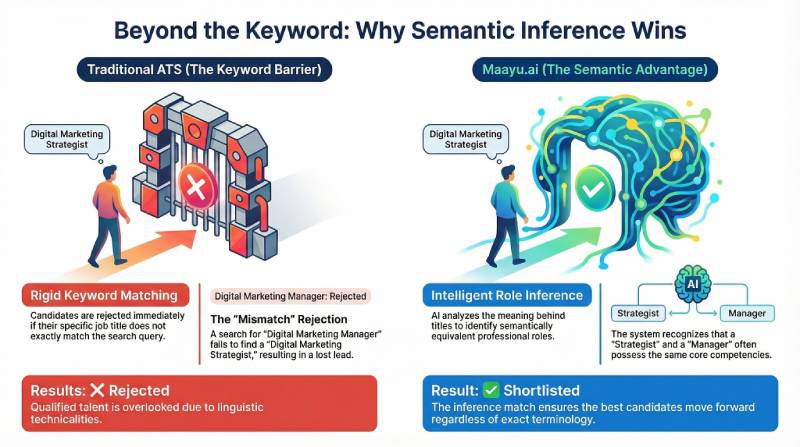
Case in point, a digital marketing strategist using the job title of digital marketing manager or someone skilled in Ruby on Rails using RoR.
At Maayu.ai, we solve this problem firsthand by using inference-based AI to analyze semantic meaning, understand context, identify skill equivalencies, and detect trends in career progression.
- Our platform uses LLM-based inference decision-making to shortlist candidates based on technical and behavioral parameters, analyzing data from the entire hiring funnel and prior employment history.
“An International Journal of Research Publication and Reviews study on AI-enabled recruitment found that leading organizations such as Unilever and IBM achieved around a 30% improvement in quality of hire and a 75% reduction in time-to-hire after implementing AI-driven assessments and screening.”
Also Read: Resume Optimization Beyond Keywords for Smarter AI Screening
Tip 3: Capture Conversation Data for Intelligence-Gathering and Skill Matching
Most recruiting teams still treat conversations as one-off events rather than intelligence-gathering sessions.
Interviews, phone screens, and casual check-ins are filled with details about skills, projects, constraints, and preferences that never make it into the ATS in a structured way.
- That means valuable information is effectively lost after each call, and recruiters are forced to reask the same questions or rely on memory.
An AI-first approach fixes this by automatically turning conversations into structured candidate data.
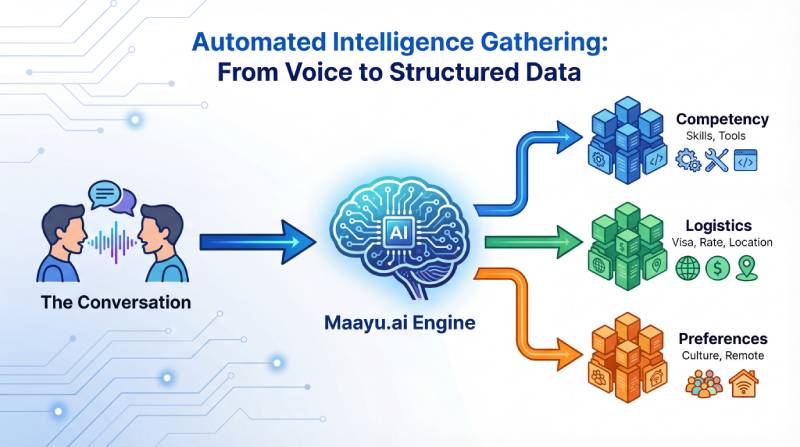
Instead of just storing raw transcripts or scattered notes, the system (could be an ATS here), can extract and normalize key fields from a notetaker such as Fireflies, Cluely, or others, and summarize them under three intelligent buckets:
Competency:
- Skills and tools actually used in real work, not just listed once on a resume
- Depth of experience and true scope of responsibility
- Industries, problem statements, operating environments, and regulatory exposure
Logistics & Compliance:
- Security clearances, licenses, and compliance limitations
- Location preferences, work authorization status, and timezone alignment
- Compensation expectations, non-negotiables, and flexibility
Preferences & Fit:
- Start date, notice period, and overall availability
- Role expectations and culture fit: team size, leadership ownership, and remote vs. on-site preference
Once captured, these details are stored in the hiring system as searchable fields, tags, or structured notes. Recruiters can then:
- Run far more precise searches, such as a candidate who led a team of 8+ engineers in Fintech on AWS instead of just AWS.
- Quickly rediscover and re-engage past candidates when a new role matches what they said they wanted.
- Compare candidates on consistent, structured criteria rather than subjective, scattered notes.
Leveraging AI thus turns this conversation data into a reusable intelligence-gathering asset — through which you can better match fitment, shortlist, and perform a smarter outreach, even for future roles.
Tip 4: Automate the Entire Recruiting Workflow
The magnitude of time wasted in manual recruiting processes is hard to ignore.
According to the Bullhorn GRID 2025 Industry Trends Report, recruiters currently spend an average of 17.7 hours per week on manual administrative tasks alone. Of these, 14.6 hours are spent on candidate sourcing alone. These are tasks that AI can easily automate. In fact, the same report reveals that a fully autonomous sourcing & matching could save nearly 3.6 hours each week on screening tasks, and upto 4.6 hours a week on searches.
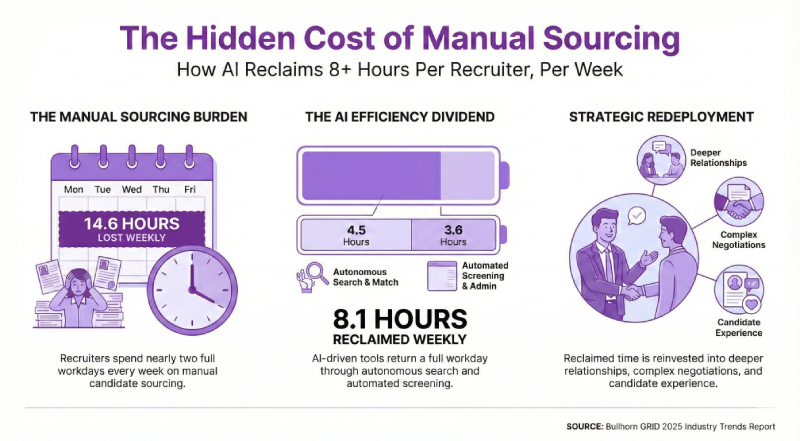
💡The opportunity cost is real money.
The Economic Reality
At maayu.ai, we modeled and extrapolated this recruiter inefficiency on a typical 100-person staffing agency. The results were stark. We observed that, by automating the sourcing and other administrative workflows, a mid-sized agency could realize:
- ~$700,000+ in annual internal cost savings by repurposing wasted recruiter hours.
- $1.3 Million in potential incremental margin by increasing placement capacity without adding headcount.
- ~40% Reduction in time-to-fill, saving clients millions in lost productivity.
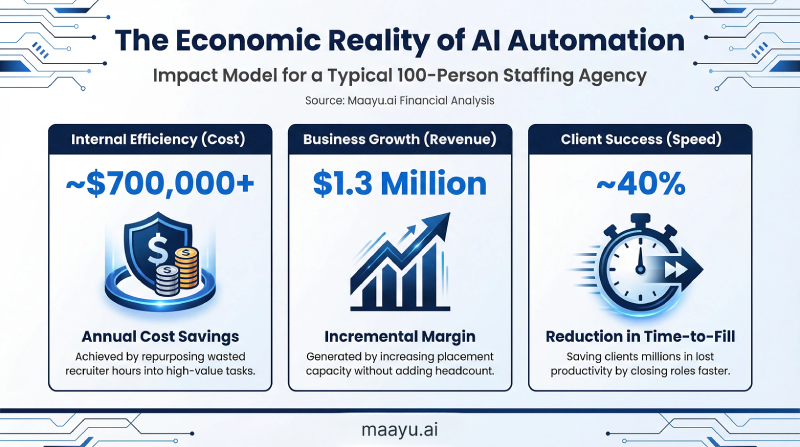
We have published the full financial model and line-by-line breakdown in our separate case study: The ROI of AI in Staffing – A Financial Deep Dive
Automating the recruitment workflow isn’t about replacing your recruiters, It is about freeing them to close the candidates that AI finds for them.
Tip 5: The Recruiter’s Edge in 2026 is Human Decision-Making
The fear that AI will replace recruiters misunderstands both technology capabilities and hiring dynamics.
Research reliably shows that AI augments, rather than eliminates, recruiting roles. Case in point, 89% of recruiters using AI report that it saves time, and 42% say they would lose massive productivity gains if AI tools were removed.
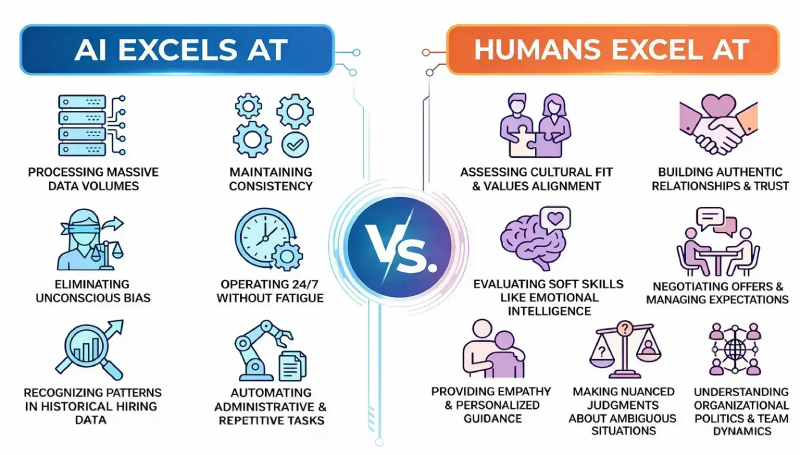
Organizations that will win in 2026 treat AI as a lever that amplifies human skills rather than as a substitute for them.
New Division of Labor
The winning formular for 2026 is simple:
AI handles the VOLUME, while recruiters own the VALUE.
AI should handle high-velocity, high-volume routine tasks such as screening thousands of resumes, scheduling interviews, followups, and other such administrative tasks. This means, recruiters will now be able to handle real transformational work. This includes complex relationship building, counseling hiring managers, negotiating offers, and ultimately closing deals.
Conclusion
At Maayu.ai, we’ve built our platform on this philosophy. The result is recruiting that’s faster, fairer, and more effective than either humans or machines could achieve alone.
The recruiters who thrive in 2026 won’t be those who resist AI or those who blindly trust it. They’ll be the ones who tap into its power while preserving their social intelligence to close deals and create a better-tailored candidate experience that makes recruiting pleasant for everyone.
Prepared to Revolutionize Your Recruiting With AI?
Visit Maayu.ai to schedule a demo and see how our platform can help your team implement these five principles to achieve measurable improvements in time-to-hire, cost-per-hire, and quality-of-hire.